When Low Goes Too Far: The Brutal Reality of Stance Builds That Can't Leave the Driveway
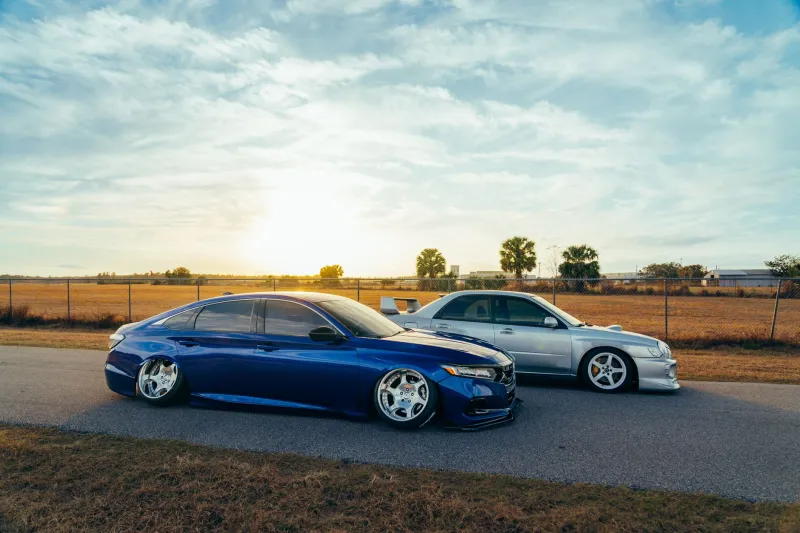
There's a moment every stance builder knows. You've finally nailed the fitment. The wheels are tucked just right, the body is kissing the fenders, and from the right angle in the right light, that thing looks absolutely untouchable. You post the photo. The comments go crazy. Life is good.
Then you try to drive it to work.
The reality of aggressive stance modifications is something the community doesn't always talk about openly—at least not until someone's stuck at the bottom of a parking garage ramp with a busted oil pan and a line of angry commuters behind them. This isn't a piece about telling you how low to go. That's your call. But it is a real conversation about where the line lives, what happens when you cross it, and why so many builders end up quietly walking back choices they once thought were gospel.
The Tipping Point Nobody Marks on the Spec Sheet
Stance modification exists on a spectrum. A tasteful drop with proper coilovers and dialed-in alignment? That's a build that can still function as a vehicle. Aggressive negative camber, maxed-out static drop, stretched tires, and a front lip that grazes pavement on a flat road? That's a different animal entirely—and the gap between those two versions of "low" is where most builds go sideways.
The problem is that the tipping point isn't always obvious when you're in the middle of building. You go a little lower, it looks better. You push the camber another degree, the fitment tightens up. Every individual decision makes sense in isolation. It's only when you step back—or try to navigate a speed bump doing 3 mph—that the cumulative effect hits you.
Jordan, a builder out of Phoenix who runs a heavily modified Genesis Coupe, described it this way: "I kept chasing the look in pieces. Each adjustment was like, yeah, that's better. And then one day I pulled out of my driveway and scraped so hard I thought I blew a tire. I hadn't changed anything. It was just the first time I'd really tried to drive it like a car."
What Actually Breaks First
Let's get specific, because vague warnings don't help anyone. When a build crosses from aggressive into genuinely impractical, here's the order of casualties:
Tires. Stretched fitment and extreme negative camber destroy the inner edge of your tires faster than almost anything else. You might be running a quality tire, but if it's sitting at -4 degrees of camber, you're burning through the contact patch unevenly and constantly. Builders who run this setup daily are often replacing tires every few thousand miles—and those aren't cheap miles.
Wheel bearings. This one sneaks up on people. Camber angles that look clean in photos are applying lateral load to your wheel bearings in ways they were never engineered to handle. The bearing starts complaining with a hum. Then it gets louder. Then you're replacing it—and if you're running aftermarket hubs or spacers, that job gets expensive and complicated quickly.
Suspension components. Ball joints, tie rod ends, control arm bushings—anything in the front suspension takes a beating when your geometry is pushed to the extreme. The angles create stress points that accelerate wear dramatically. A component that might last 60,000 miles on a stock setup could be done in 15,000 on a heavily cambered build.
The undercarriage. Oil pans, exhaust components, lower control arms, subframe edges. When your clearance is measured in millimeters, every railroad crossing, every steep driveway apron, every pothole that catches you off guard is a potential impact. Marcus, a builder in Atlanta who runs a static-dropped Civic, put it plainly: "I've replaced my front lip four times in two years. At some point I had to ask myself if I was building a car or just a very expensive prop."
The Guys Who Had to Walk It Back
What's interesting about talking to builders who've been through this is how consistent the turning point is. It's almost never one catastrophic event. It's attrition. It's the slow accumulation of inconveniences—the routes you stop taking, the parking garages you avoid, the trips you decline because you just don't want to deal with the car that day.
Derek built a slammed Subaru WRX that spent two years as his daily driver in the Pacific Northwest. "The stance was perfect. I mean, it photographed like a dream. But I was planning my entire life around that car's limitations. I knew every bad intersection in a ten-mile radius. I knew which gas stations had steep aprons and which ones I could use. I was routing around road construction because I couldn't clear the temporary plates they put over the trenches. That's not a car anymore. That's a puzzle you solve every day."
He eventually raised it two inches, adjusted the camber back toward street-functional numbers, and says the car still looks aggressive but actually goes places now. He doesn't regret the change. What he regrets is not thinking through the daily reality before he committed to the extreme setup.
Building Aggressive Without Building Yourself Into a Corner
None of this is an argument against stance culture. It's an argument for going in with your eyes open and a plan that matches your actual lifestyle.
If the car is a dedicated show piece that lives on a trailer and gets driven maybe 500 miles a year, push it as far as the build concept demands. The compromises are real but manageable when the car isn't your daily reality.
If you're driving it every day or even most weekends, the conversation changes. Air suspension has become genuinely capable—modern setups let you run show-level drop when you want it and functional ride height when you need it. The cost is real, but so is the flexibility. Plenty of builders have found that the ability to actually use their car is worth every penny of the air management system.
The other approach is simply being honest about where you draw the line before you start cutting. Decide what the car needs to do, then build to that ceiling. You can still go aggressive. You can still have fitment that turns heads. You just might stop one click before the point where your oil pan becomes a sacrificial component.
The Photo Doesn't Tell You Everything
Car culture in 2025 is heavily mediated through screens, and stance builds photograph exceptionally well. That's part of the appeal and also part of the trap. The image flattens everything—it doesn't show you the scrape marks, the worn inner edges, the rerouted commute. It just shows the drop and the fitment and the light catching the wheel just right.
The builds that really hold up over time are the ones where the builder understood the difference between what the camera sees and what the car actually lives through. Flash your rack all day—that's what this is about. Just make sure you can actually drive it to the show.