Flashing Lights and Flashing Badges: The Mod Builder's Guide to Staying Legal on the Street
Let's be honest — half the fun of building a car is turning heads. The other half is not getting a $400 ticket on the way home from a meet. But somewhere between those two goals, a lot of builders are operating on straight-up mythology when it comes to what's actually legal.
Underglow is illegal everywhere. Tinted windows are fine as long as they look dark. Straight pipes are a gray area. Sound off at any car meet and you'll hear a dozen confident takes, most of them at least partially wrong.
We dug into state statutes, talked to a handful of builders who've had real run-ins with law enforcement, and got some straight answers from traffic attorneys who deal with this stuff professionally. Here's what you actually need to know.
Underglow: The Mod That Lives in a Permanent Legal Gray Zone
Underglow is probably the most misunderstood modification in the game. The short answer is: it depends entirely on color and state.
In most states, underglow itself isn't explicitly banned — but the color absolutely matters. Red and blue lights visible from the front or rear of a moving vehicle are illegal in virtually every state because they can be mistaken for emergency vehicle lighting. White lights facing rearward can get you tagged for improper lighting. Amber tends to be the safest bet in most jurisdictions, though even that varies.
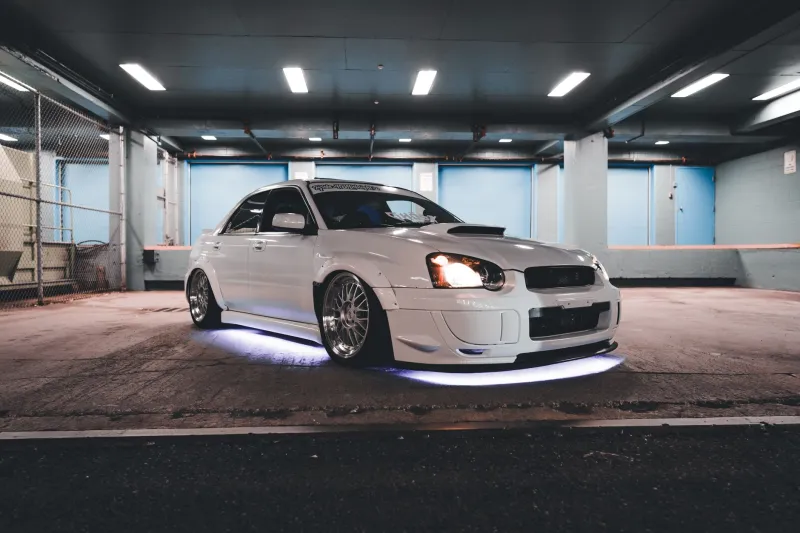
California, Florida, and Texas are three states where underglow sits in a genuinely murky zone. California's Vehicle Code Section 25102 allows underglow as long as it doesn't display red to the front or blue at all — but enforcement is inconsistent. Florida actually permits neon underglow on non-moving vehicles, which means you're fine at a show but technically in violation cruising the strip. Texas follows similar logic.
Marcus T., a Houston-based builder who runs a bagged C10, found out the hard way. "I had amber underglow, thought I was good. Officer pulled me over, said the issue was that it was 'distracting to other drivers.' That's not a specific statute — it's a catch-all. Ended up being a warning, but it cost me 45 minutes on the side of 290."
The takeaway: check your specific state's vehicle lighting code, not a Reddit thread from 2019.
Window Tint: The One Everyone Gets Wrong
Window tint laws are some of the most aggressively enforced modification rules on the books, and they vary wildly by state. The measurement that matters is VLT — Visible Light Transmission — expressed as a percentage. Lower percentage means darker tint.
In Arizona, you can run 5% on rear windows. In New York, 70% is the minimum on front side windows. Those are not the same universe.
What builders often miss is that front side windows are regulated differently than rear windows in almost every state. You might be totally legal in the back and still catch a fix-it ticket for your driver's window.
Attorney Sandra Reyes, who handles traffic violations in the Southeast, puts it bluntly: "Tint tickets are low-hanging fruit for officers. It's a visual inspection, it takes 30 seconds with a meter, and the fines are consistent. If you're running illegal tint, you will eventually get caught — it's just a question of when."
Exhaust Noise: Loud Isn't Always Illegal, But Loud Enough Usually Is
Here's where builders tend to get overconfident. Straight pipes, cutouts, and aggressive exhaust setups exist in a patchwork of state and municipal regulations that are notoriously hard to pin down.
Most states have decibel limits on paper — California caps passenger vehicles at 95 dB, measured from 50 feet. But the practical reality is that few patrol officers carry sound meters. Enforcement typically comes down to officer discretion, which means your 3 a.m. rip through a quiet neighborhood is a much bigger problem than the same car at a sanctioned event.
Jordan K., who built a boosted EJ Subaru in the Pacific Northwest, described a stop that ended better than expected. "Officer pulled me over, listened to the car for a minute, and said 'that's loud but I'm not going to write you up today.' He was clearly a car guy. Different cop, different outcome."
The "car guy cop" factor is real, but it's not a legal strategy.
Lighting Kits, LED Halos, and Headlight Colors
Aftermarket headlight setups — projector builds, halo rings, color-shifted LEDs — are an area where the federal standard actually matters more than state law. DOT compliance is the threshold. If your headlights aren't DOT-approved, you're technically in violation in all 50 states, regardless of how clean the build looks.
Blue-tinted headlights are a particular problem. They look cool, they photograph well, and they'll get you pulled over in most states because blue-white output above a certain color temperature can be confused with emergency lighting.
What Cops Generally Aren't Sweating
For balance — because this isn't a scare piece — there are mods that technically exist in gray zones but rarely attract enforcement. Mild body kits, most wheel fitment setups, cold air intakes, and interior lighting that isn't visible from outside the vehicle are all things that officers routinely drive past without a second look.
The pattern that emerges from both the builder interviews and the legal perspective is this: enforcement tends to follow visibility and safety perception. If your mod looks like it could confuse other drivers or impersonate emergency equipment, you're a target. If it's a performance upgrade that doesn't change how the car presents on the road, you're probably fine.
Build Smart, Not Sorry
The builders who stay out of trouble aren't necessarily running boring setups. They're just doing their homework. A quick read of your state's vehicle code — specifically the lighting and equipment sections — takes maybe an hour and can save you a stack of fines and a headache at inspection time.
The flashiest builds on the street aren't always the ones that cost the most. Sometimes the smartest flex is knowing exactly where the line is — and building right up to it.